
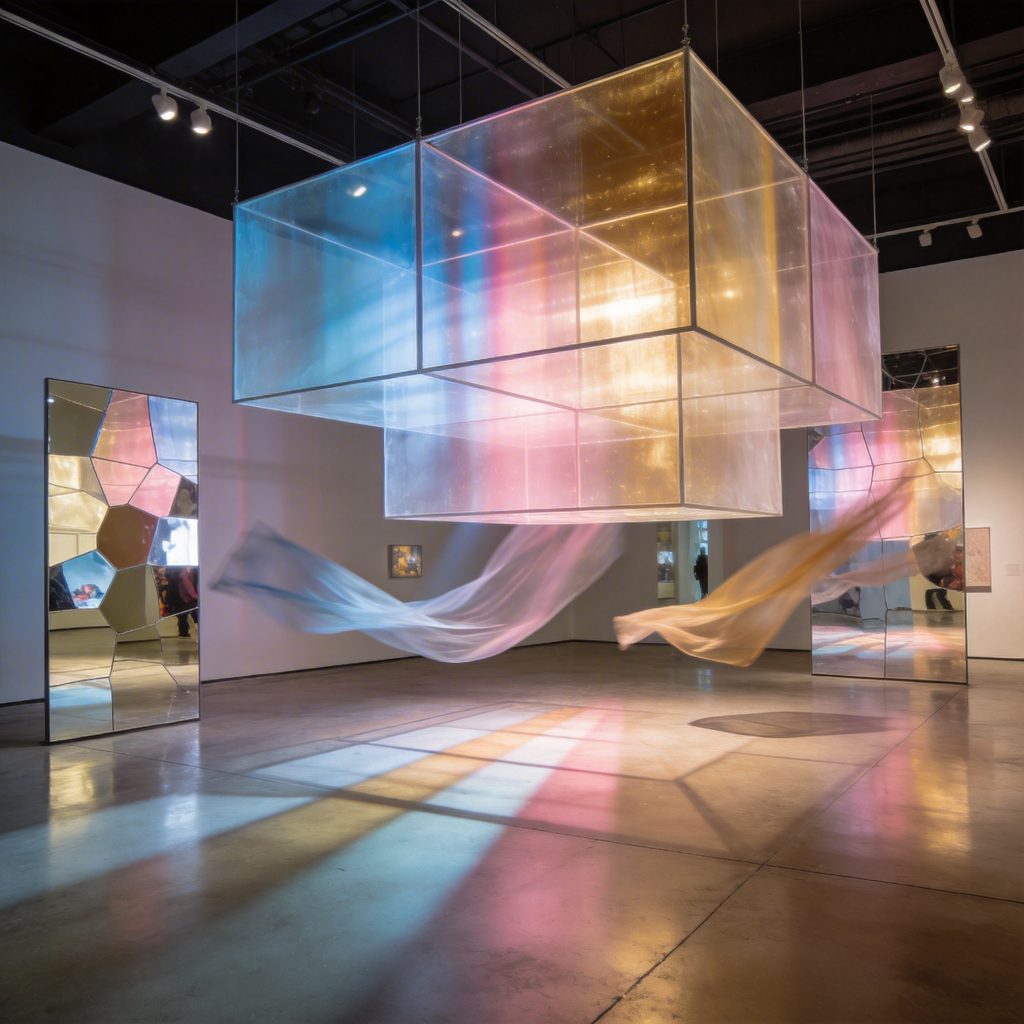
Beyond the Frame: How Immersive Installations Are Redefining Art and Experience
 admin
admin
For centuries, the relationship between art and audience was largely one of observation. We stood before a painting, respectfully distanced, or circled a sculpture, admiring its form. The experience, while powerful, was contained by the frame and the pedestal. Today, a seismic shift is underway, driven by a form of artistic expression that doesn’t just ask for your attention—it swallows you whole. Welcome to the world of the immersive installation, a multi-sensory, often large-scale environment designed to completely surround and engage the participant. More than a trend, it’s a fundamental reimagining of what art can be: not a static object to be viewed, but a dynamic space to be inhabited, felt, and co-created.
At its core, an immersive installation breaks down the traditional “fourth wall” of artistic presentation. It leverages a combination of physical space, digital technology, sound, light, and sometimes even scent and touch to construct an alternate reality. The goal is to evoke a profound emotional or psychological response, making the visitor an integral part of the artwork itself. From the globally touring digital wonders of teamLab to the hauntingly beautiful mirrored infinity rooms of Yayoi Kusama, these experiences are moving art from the exclusive halls of museums into the realm of mass cultural phenomena, proving our deep-seated desire for wonder and connection in an increasingly digital age.
The Core Elements of a Captivating Immersive Experience
Creating a successful immersive installation is a complex alchemy. It’s not merely about projecting a video on a wall; it’s about orchestrating every element to build a cohesive and convincing world. While approaches vary wildly, several key components consistently define the most impactful works.
1. Environmental Dominance and Scale
The first step to immersion is the elimination of the “outside” world. Artists achieve this by controlling the entire environment. This often means large, cavernous spaces—warehouses, former industrial buildings, or specially constructed pavilions—where every surface becomes a canvas. Floors, ceilings, and walls are transformed through projection mapping, fabric, light, or physical structures. The scale is deliberately overwhelming, making it impossible to see the “edges” of the artwork, thus fostering a sense of being inside the artist’s vision rather than outside looking in.
2. Multi-Sensory Engagement
True immersion speaks to more than just the eyes. Sound design is paramount; a meticulously crafted spatial audio score can direct movement, evoke emotion, and deepen the sense of place. Think of the echoing drips in a digital rainforest or the pulsating soundtrack of a cybernetic landscape. Some installations incorporate haptic feedback (vibrating floors), controlled temperature, or even olfactory elements (smells of rain, forest, or concrete) to create a fully embodied experience. This multi-sensory approach bypasses pure intellect and connects directly with visceral feeling and memory.
3. Interactivity and Participant Agency
This is where the modern immersive installation truly diverges from its predecessors. Many works are interactive, responding to the presence, movement, or choices of the visitor. Motion sensors, pressure pads, and camera tracking allow the digital environment to react. You might see your shadow burst into a flock of birds, or your touch on a wall might trigger a bloom of virtual flowers. This interactivity creates a powerful feedback loop: the participant’s actions shape the art, which in turn elicits new actions. It fosters a sense of agency and co-authorship, making each person’s journey through the space uniquely their own.
From Galleries to Mainstream: The Cultural Impact of Immersive Art
The rise of immersive installations is more than an art world novelty; it reflects broader cultural and technological shifts. As our daily lives become increasingly mediated through screens, there is a growing hunger for “real” experiences—ones that are physical, shared, and memorable. Immersive art meets this demand by offering a form of digital interaction that is profoundly analog in its requirement for physical presence.
This has led to the democratization of art consumption. Blockbuster immersive experiences, often centered around popular artists like Van Gogh or Frida Kahlo (through digital reinterpretation), draw crowds that might never set foot in a traditional museum. They are designed for social sharing, with their photogenic, awe-inspiring vistas becoming fodder for Instagram and TikTok. While this “Instagrammability” is sometimes criticized, it undeniably broadens access and sparks conversations about art in the public sphere.
Furthermore, the principles of immersive installation are bleeding into other industries:
- Retail & Brand Marketing: Flagship stores and pop-up brand experiences use immersive tech to create emotional connections with products, transforming shopping into a narrative journey.
- Education & Museums: Historical sites and science museums use immersive environments to transport visitors to ancient Rome or the depths of space, making learning experiential and engaging.
- Theatre & Performance: The line between stage and audience is blurring with immersive theatre, where patrons move through a storyworld, influencing the plot through their interactions.
Challenges and Considerations: The Flip Side of the Experience
Despite its wonders, the world of immersive installation is not without its complexities and critiques. For artists, the financial and technical hurdles are significant. Creating these works requires a village—not just a solitary painter, but teams of programmers, engineers, sound designers, and architects. This can make production prohibitively expensive and reliant on institutional funding or corporate sponsorship.
There’s also an ongoing critical debate. Some traditionalists question the depth of such experiences, labeling them as spectacular but superficial “entertainment” rather than serious art. The focus on sensory overload, they argue, can come at the expense of conceptual rigor and quiet contemplation. Additionally, the very popularity of these exhibits can undermine the immersion, as navigating a crowded room of people taking selfies can break the magical spell the artist worked so hard to create.
For the visitor, it’s worth considering what we bring to these spaces. To get the most out of an immersive installation, one must be willing to surrender to the experience—to put away the phone (at least for a few minutes), to move slowly, to engage with the interactivity offered, and to be present in the moment. It is an active, not a passive, form of consumption.
Conclusion: The Future is a Space We Step Into
The immersive installation is not a passing fad, but a definitive marker of contemporary art’s evolution. It responds to our human need for awe, for shared experience, and for new ways of understanding our place in a technologically saturated world. By dissolving boundaries—between artist and audience, between digital and physical, between observation and participation—it opens up thrilling new possibilities for storytelling and emotional connection.
As technologies like virtual reality, augmented reality, and artificial intelligence continue to mature, the language of immersion will only grow richer and more sophisticated. Yet, the core principle will remain: the power of art to build a world around us. The future of experience, it seems, lies not on a screen we hold in our hands, but in the spaces we step into with our whole being. The frame is gone, and the canvas is all around us, waiting for our presence to complete the picture.
